
Compare the Values on a Polk County Property
A Polk County property card can show several values at once. The assessor estimates fair market value for the tax digest. Georgia then applies a 40 percent assessment level. The sales history may show consideration from a past deed. Each figure answers a different question.
| Value | What It Is | Where |
|---|---|---|
| Assessed value | Georgia's taxable assessment level, generally 40% of fair market value | Assessor card and notice |
| Fair market value | The assessor's full-value estimate for the digest | Assessor card and annual notice |
| Last sale price | Consideration reported for a transfer, which may not be market-based | Deed, PT-61, and sales history |
| Land and improvements | The component values behind the total | Assessor card |
That 40 percent assessment level is a tax rule. It is not a discount on what a Polk County parcel would fetch at sale, and exemptions can shift taxable value while the market price stands still.
Read Polk County Land, Building, and Total Values
The assessor points to qPublic for assessment values, characteristics, ownership, maps, and sales history. An official Polk appraisal sample goes further. It separates land, improvements, and total value and names the assessment year. So you can see whether a change attaches to the site, a building, or both.
The same sample carries deed book-page, plat book-page, sale date, grantor, and grantee. It also lists sale price and a reason code. That code matters. Not every recorded price is an arm's-length market indicator. So read the reason with the deed.
A Polk County Last Sale May Say Zero Dollars
The official sample lists unqualified transfers with zero-dollar prices. Zero does not mean worthless. The stated consideration simply does not measure open-market value. Read the reason code and the recorded deed before using the figure.
PT-61 conveyance data and GSCCCA sales-price information can add transfer context, but neither turns a non-market conveyance into a comparable sale.
Estimate a Polk County Property Value from the Roll
Open the Polk qPublic search and find the parcel by its address or parcel number before trusting any value field. Confirm the situs. Check the legal description too, because a postal city can cross a municipal boundary.
- Search the address, then verify the parcel and legal description.
- Record the fair market, assessed, land, improvement, and total values with their year.
- Open the sales row and note its date, price, reason, and deed reference.
- Read the deed or PT-61 context before comparing that transfer with value.
- Assessed value
- The value produced by applying the state assessment level.
- Fair market value
- The assessor's full-value estimate for tax administration.
- Assessment ratio
- The percentage relating assessed and fair market value.
- Reassessment
- A later review that can change the digest value.
See Polk County's Value Notice Source
The official Board of Assessors page supplies the county's value notices and qPublic route.
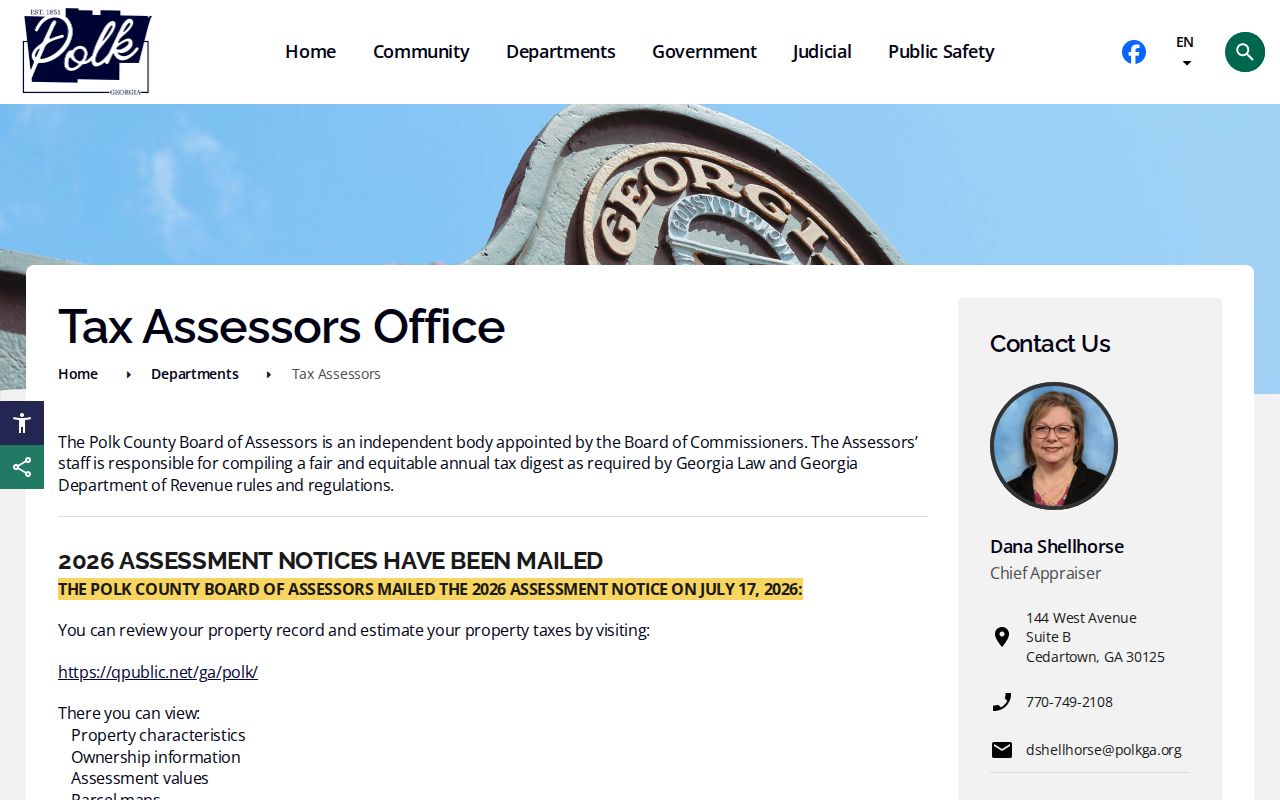
The county notice page ties values to the 2026 cycle.
The 2026 Polk County Value Cycle Matters
Polk County said on July 8, 2026 that values and exemptions were under review. On July 17 the notices went out. A value needs its notice date. An undated figure is not a live quote.
The county's estimator uses the market value on the notice and the tax district. Later changes and millage rates can still move the bill. For bills and appeals, the Polk County property tax page covers that process. This page sticks to what a value means.
Separate Polk County Assessed and Taxable Values
Polk's standard homestead exemption shields the first $2,000 of assessed value when its requirements are met, and the county describes additional age, income, and disabled-veteran categories. That changes the taxable math only. It does not rewrite what a buyer paid.
Homestead status can support an owner-occupancy inference. But it is not title proof, and it does not establish present market price, so keep exemptions out of any sale-price comparison.
Read a Polk County Property Value in Context
Start with the assessment year and write it down before copying any number. Then separate land value, improvement value, total fair market value, assessed value, and any taxable figure the card actually labels. The exact wording matters. Each figure serves a different purpose in the county record. If the live result uses other labels, go with them and never invent a field.
Next, inspect the characteristics the assessor publishes. These include use, improvements, or other parcel details. Do not assume a complete condition report. Values change for many reasons. A shift can reflect a reassessment, a property change, corrected data, or another digest action. The July 2026 review and notice dates prove the point. Values move through a documented annual process.
For the transaction side, record the sale date and sale price. Add the reason code, grantor, grantee, deed book-page, and plat book-page where shown. A zero-dollar transfer proves nothing about worth. Family, fiduciary, and entity transfers often carry consideration that never measures an arm's-length exchange. Read the deed and the PT-61 context first. Only then treat a row as a comparable sale.
If qPublic is blocked, call the Board of Tax Assessors at 770-749-2108 for the assessment record. The Tax Commissioner runs a separate tax site and offices for bills and payments. That split matters. The assessor builds the digest values. The Tax Commissioner applies the tax administration shown on the bill.
Polk County Record Geography Adds Context, Not Price
Cedartown's courthouse grid, Rockmart's railroad strip, and Aragon's mill-village lots come from different development eras. Eras shape records. Historic districts, industrial tracts, rail corridors, and rural metes-and-bounds parcels all appear across Polk County. That explains why two nearby records carry different land and improvement histories. None of that is a valuation formula. A decision may need a present market opinion. Rely on the parcel's current characteristics and a qualified appraisal.
Date Polk County Value Sources Before Comparing Them
Dates give Polk County value figures their meaning. Match labels before you match numbers. The assessed and fair market values carry a tax year. Sale consideration carries a transfer date. The annual digest runs on a notice date. A sale that closed after an assessment cannot explain that assessment. Never treat it as the cause.
If qPublic is down, request the current property card from the Board of Tax Assessors. Give the parcel number. Deed and PT-61 context lives with GSCCCA or the Clerk of Superior Court. Billing and payment questions go to the Tax Commissioner. Questions about how the fair market estimate was derived do not.
An open-records request works best when it is precise. Name the parcel, the assessment year, the exact record, and the format you want. Georgia agencies generally respond within three business days. Otherwise they supply a written timetable, an estimate, and any exemption citation. The custodian has no duty to produce a fresh valuation report or appraisal.
Use Each Polk County Value for Its Proper Purpose
Each Polk County number answers one question. The fair market estimate and assessed value exist for tax administration. A deed or PT-61 consideration amount belongs to the transaction record itself. A licensed appraisal is a professional opinion tied to a stated date and use. Numbers sitting side by side are still not interchangeable.
Old values help with house history. They can show when the digest shifted. Yet they prove nothing about renovation or condition on their own. For purchase diligence, the assessment is a public benchmark. A sale row needs its reason code and deed context. For a tax dispute, rely on the assessment year and the notice. Use the county process rather than any private estimate.
Know What a Polk County Assessed Value Cannot Prove
The assessor's number supports the tax digest, nothing more. It does not promise a sale price or vouch for the condition of every improvement, and it cannot replace a property-specific appraisal. A past sale may also have been non-market, and a recent improvement might not appear on the card yet.
Value versus price. A Polk County assessed value is for taxation and is not what the property will sell for. It is not an appraisal.
Treat the assessor record as one dated public value source, not the final word. For a real market decision, walk the property. Then get a qualified opinion suited to that choice. Keep a copy of the dated card or notice. A later reassessment can otherwise erase the basis of your comparison.