
Trace Former Polk County Property Owners
Prior owners form a chain, not a finished list. Start at the newest deed for the current parcel. Work backward one conveyance at a time, reading each grantor and grantee in turn. Copy the legal description and plat reference beside every name so the trail never drifts onto other land.
| Source | Years It Covers | Where Held | What It Shows |
|---|---|---|---|
| Kofile deed index | 1969-1979 | Polk QuickLink | Party index and book, volume, page controls |
| GSCCCA real-estate index | Polk span not stated on public menu | Statewide portal | Name, book-page, and broader deed references |
| Kofile plat index | 1940-2020 | Polk QuickLink | Plat names, lots, and recorded book references |
| Physical deed books | Older chain as held | Superior Court Clerk | Earlier transfers when online indexes stop |
Kofile's online indexes cover limited spans, not the full reach of Polk County land records. The clerk's terminal and physical holdings fill the gap for prior owners outside those ranges.
Build a Polk County Deed-Chain Timeline
A backward table keeps facts from drifting apart. Enter only what each recorded instrument actually shows. Treat the sample rows as illustration, not as claims about a particular property.
| Transfer date | Grantor to grantee | Deed type | Book and page |
|---|---|---|---|
| Newest recorded date | Prior owner to current grantee | As indexed | Newest reference |
| Earlier recorded date | Earlier grantor to prior grantee | As indexed | Earlier reference |
| Chain break | Estate, entity, or missing index link | Investigate separately | Probate, clerk book, or plat lead |
Repeat the pattern to the target date. Stop only at a genuine records gap, since a chain of title is an ordered sequence of conveyances, not a list of people who shared one address.
Walk the Polk County Deed Chain Backward
Start with qPublic's current owner record. Note any deed book-page in the sale history, then search the newest grantee through the GSCCCA index. The instrument itself supplies the grantor and legal description.
- Find the current owner's acquisition deed with that owner as grantee.
- Record the grantor, date, instrument type, and land description.
- Search that grantor as the grantee in an earlier acquisition.
- At an index cutoff, continue through the clerk's terminal and physical books.
- Grantor
- The party conveying an interest.
- Grantee
- The party receiving it.
- Reverse index
- An index organized to find grantees as well as grantors.
- Quitclaim and warranty deed
- Different instrument forms whose exact legal effect comes from the document and law.
Keep Polk County Prior Owners Tied to the Plat
Street addresses change. Postal city names do not define corporate limits. A plat book-page, subdivision and lot, land lot and district, or metes-and-bounds description keeps prior owners tied to the same Polk County land, and the Kofile page lists plat indexes from 1940 through 2020. Plat books A through Z sit there too.
Splits complicate the trail. A parcel split or combination can retire one tax identifier and create another. When that happens, follow the older legal description and the parent tract instead of forcing the current parcel number onto every old deed.
Resolve Estate Breaks in Polk County Ownership History
Not every ownership change is a sale. An executor, administrator, trustee, or life estate can break a clean sequence of prior owners. An "Estate of" caption does the same. Search that fiduciary wording exactly. Polk County Probate Court records supply the missing authority. An estate proceeding may sit behind the transfer.
Watch zero-dollar and unqualified sale rows. The official Polk appraisal sample lists sale-reason codes. It also names grantor, grantee, and deed and plat book-page fields. The recorded instrument, not the dollar figure, explains the transfer.
Bridge Polk County Name and Address Gaps
Old newspapers fill the gaps. Georgia Historic Newspapers carries Polk County issues from 1874 through 1922. The Polk County Historical Society holds bound papers from 1870 through 1991 at its research library. It is open Wednesday through Saturday, 11 a.m. to 4 p.m.
Estate notices and sheriff sales surface there. So do old street names. Search “Cedartown” alongside the old “Cedar Town” spelling to catch more hits. Newspaper evidence is context only. So return to the deed or probate record to prove any transfer.
Keep a Polk County Prior-Owner Chain on One Tract
Each backward step should capture more than a surname. Record the instrument date, the recording date, grantor, grantee, deed type, book-page, and the full land description. Add the parcel number only where the source shows it. When a deed cites a plat, pull that plat and compare the lot, block, subdivision, acreage, roads, and adjoining owners against the next instrument.
A name search alone can leap to unrelated land. The same person may buy several parcels, convey only part of a tract, reserve an easement, or sign with a different form of the name. Splits and recombinations retire old tax identifiers. The legal description supplies continuity when the current street address and parcel number did not yet exist.
Instrument roles matter. The grantor on the newest acquisition deed is the immediate former owner for that conveyance. To reach farther back, search that person as grantee. Find the deed by which that owner acquired the same Polk County land. Then repeat the role change. Separately indexed security deeds, liens, cancellations, and plats can explain the record, but none of them belongs in the chain as an ownership transfer.
Estate trails need probate. Note the fiduciary wording and search Polk County probate records for authority and heirs. Entity trails need the exact legal name. Georgia's business record adds identity context for companies and trusts named in a deed. The 1969 Kofile boundary is not a wall. Move on to GSCCCA, the clerk terminal, and the physical deed books, carrying the last book-page and legal description with you.
An 1851 Polk County Map Survived Off the Web
The clerk's vault hides surprises. Kofile's preservation account describes an 1851 landlocked map rescued from a discard pile and an original subdivision plat printed on fabric. The lesson is practical. Preservation can reveal what no index advertises.
Ask the clerk about vault and historical holdings when a former-owner trail ends before the online span. Not everything early was digitized. The Polk Kofile QuickLink shows the remote entrance to the historic indexes.
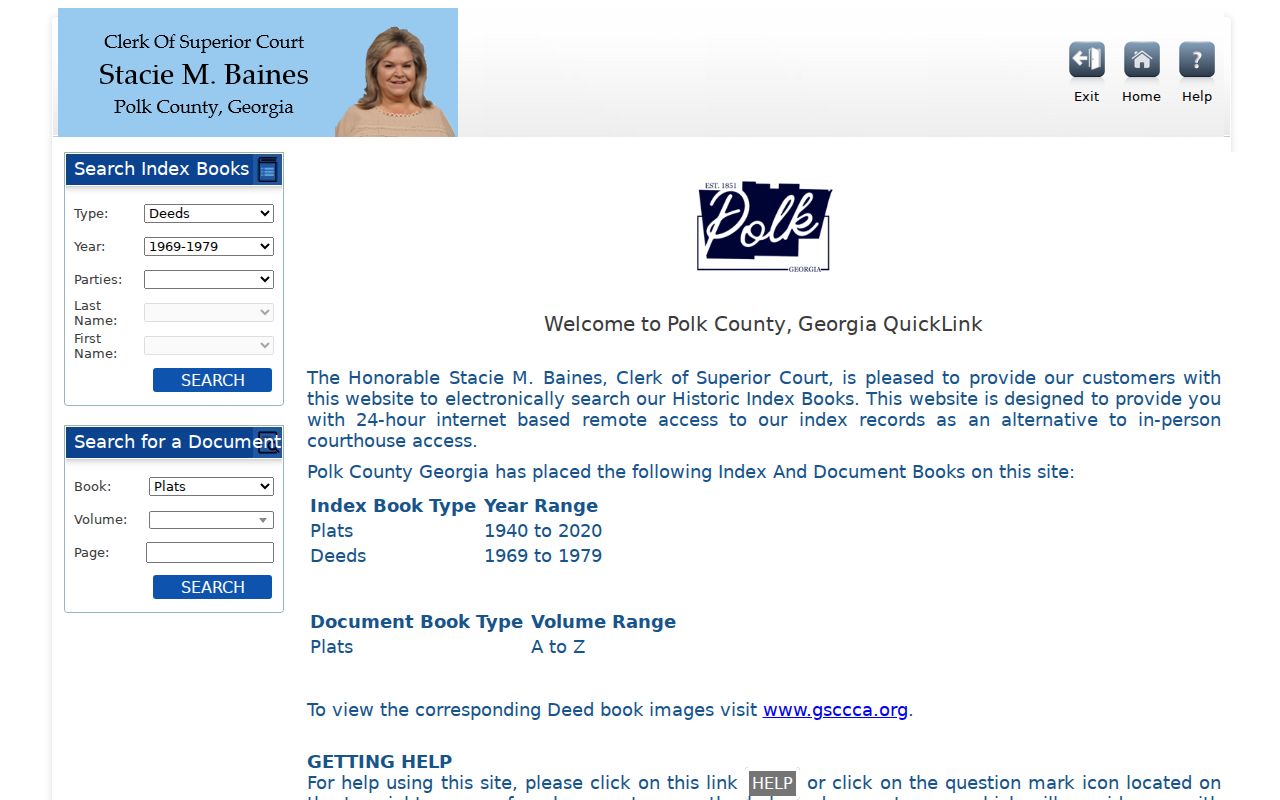
The portal covers the spans it lists, and anything older or broader still requires GSCCCA and clerk access.
Ask for Older Polk County Deed Books Precisely
When the online trail runs out, visit the clerk with specifics. Bring the last confirmed grantor and grantee. Add an approximate date and the book-page or plat reference. Add the full legal description too. Those details hand staff a precise target instead of an open-ended title search request.
A focused Georgia Open Records request works the same way. Name an existing index page, deed-book page, or scan and ask for electronic delivery. Agencies typically respond within three business days. Otherwise they provide a written schedule, a cost estimate, and any exemption citation. The first 15 minutes of search time cost nothing. Copying runs up to 25 cents per page.
Older context sometimes lives elsewhere. The Georgia Archives holds clues about forgotten names, roads, and local events. So does the Polk County Historical Society. None of that replaces a recorded instrument. Carry every clue back to the recorded land description. Only then add another former owner to the chain.
Distinguish Polk County Ownership from Occupancy History
City directories, newspapers, Sanborn maps, and obituaries all help. They can place a person or a business at an address. That is not the same as a recorded transfer. A tenant, a relative, a manager, or an operator may fill local sources. Any of them could hold no title at all. Keep occupancy clues on a separate timeline. Promote a name into the chain only with proof. A deed or another valid transfer record must back it up.
The Sanborn holdings help here. Cedartown's editions run from 1885 through 1932, and Rockmart has a 1923 set. They can reconcile old block numbers, building uses, and street changes. For legal proof, though, return to the clerk's deed and plat record.
How Far Back Polk County Prior Owners Can Be Traced
Polk County dates to 1851. No single earliest deed date or complete online cutoff applies across the board. Kofile covers only the 1969-1979 deed-index window. Earlier former owners demand the Clerk of Superior Court's books, terminals, and any parent-record references found inside the instruments themselves.
Online cutoff. Do not describe 1969 as the beginning of Polk ownership records. It is the start of Kofile's verified deed-index span.
Lawful use. Trace former owners for house history, estates, boundaries, or purchase diligence. Never use the record trail to track, threaten, or harass a living person.