
Find Out Who Owns a Polk County Property
Start with the street address. Do not stop there. Polk County connects that address to a tax parcel, links the parcel to an Owner Name, and ties the name to recorded deeds. Following that chain answers the everyday ownership question. It also keeps a tax-roll entry distinct from legal title, a difference that matters when the answer has to stand up.
- Search the address in Polk County Tax Assessor qPublic and copy the parcel number, Owner Name, situs address, and legal description.
- Use the parcel and legal description to rule out similar addresses or people with the same name.
- Confirm the newest conveyance through the Clerk of Superior Court's GSCCCA index or courthouse terminal.
- If the owner is an LLC, check its exact legal name in the Georgia Secretary of State Business Search.
Read Polk County's Owner Name Field Carefully
The assessor describes its qPublic results as covering ownership, characteristics, assessment values, and parcel maps. Sales history on file is included too. An official Polk appraisal sample labels the key field Owner Name. Read it carefully. It is not the mailing address, which shows where tax notices go. It is not the situs address either, which locates the land itself.
Four terms in the ownership trail
- Owner of record
- The person or entity named on the current public roll.
- Vesting
- The way an interest is held under the recorded instrument.
- Grantee
- The party receiving an interest in a deed.
- Situs address
- The physical property location, not the tax-mail address.
A rural tract may have no street address at all. An owner may get mail somewhere else entirely. Match all three fields to the parcel number. Weigh the legal description too before deciding who owns this property. The official Polk qPublic entrance is the online starting point for that owner card.
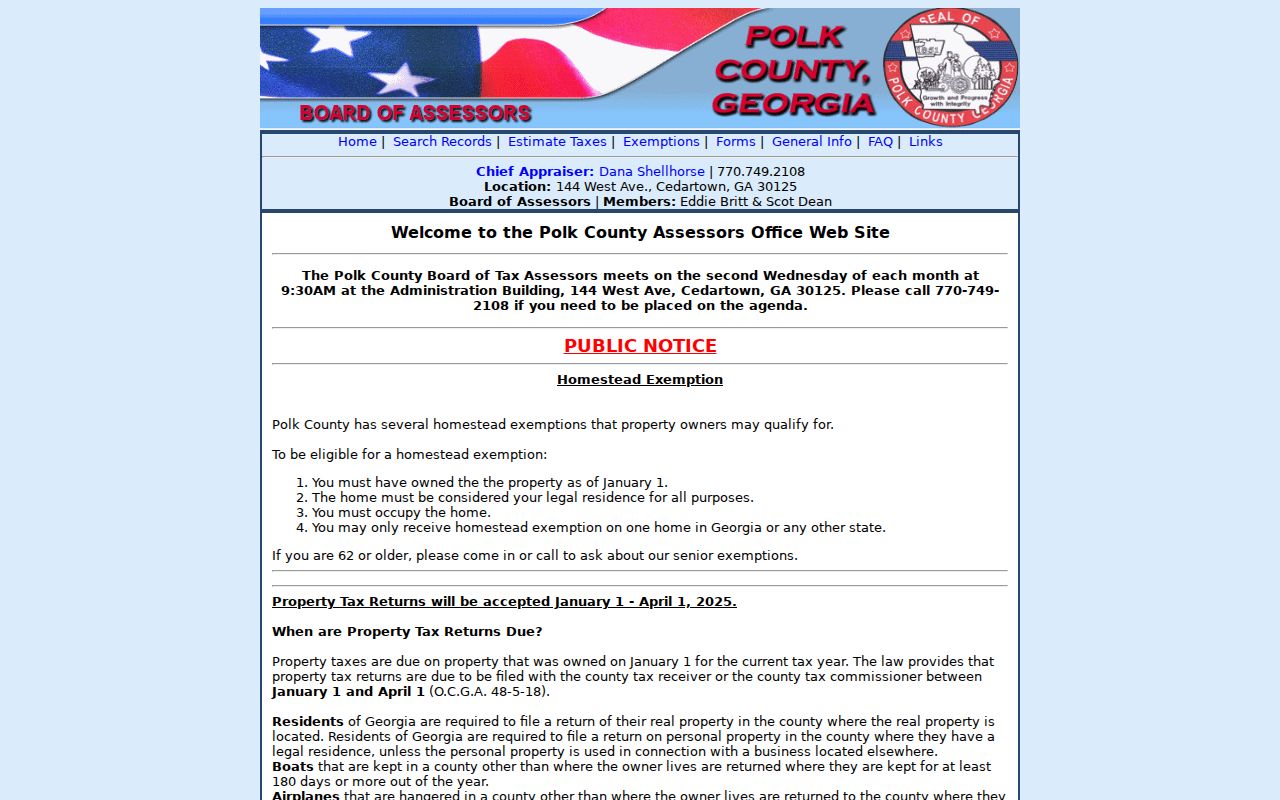
The service's own page names the product, and the assessor's instructions spell out which ownership and parcel fields a result can display.
Trace a Recent Polk County Sale to the Deed
Polk County reassesses annually. The county publishes no fixed number of days between a closing and an owner-field update. So a recent sale can leave the assessor card stale. In that case, the newest recorded deed is better evidence of the conveyance date. Use the qPublic deed book and page when one is shown, or search the current grantee in the GSCCCA Real Estate Index. Compare the grantor, grantee, recording date, and legal description against the parcel card. The clerk also offers public terminals at Courthouse No. 1 in Cedartown, Monday through Friday, 8:30 a.m. to 5 p.m.
Sources That Identify a Polk County Property Owner
No single field answers every version of the question. The Polk County assessor roll supplies the working owner name. The clerk's recorded instrument supplies the transfer evidence. Entity records can help decode a company name, but they do not establish title to land.
| Source | Owner Info It Gives | Access |
|---|---|---|
| qPublic assessment card | Owner Name, mailing and situs addresses, parcel and sale references | Free county-linked portal; office help at 770-749-2108 |
| Clerk real-estate index | Grantee on the latest recorded deed | GSCCCA, public terminal, or a focused clerk request |
| Georgia business search | Entity status, registered agent, and officers of record | Free state search |
| qPublic parcel map | Parcel identity and map context tied to the card | Free parcel-card map link |
The named owner may be an estate, trust, business, or someone who never sets foot on the site. A tax mailing address is a contact clue, not proof of where anyone lives.
Identify Polk County Trust, Estate, and LLC Owners
Owner captions take many forms. You might see "Estate of," a trustee, an executor, "et al.," or an exact LLC name. Search the caption exactly as qPublic displays it. Then try punctuation and spacing variants in the deed index. A trust may be indexed under its own name, the trustee, or both. Estate transfers may also need a Polk County Probate Court file. That file explains who had authority to sign. For a company owner, the Secretary of State search accepts a business name, control number, registered agent, or officer. Its result can identify the entity of record and a registered office. It still cannot replace the deed, the instrument that ties the entity to the land.
Polk County's Historic Index Changes the Route
Kofile QuickLink helps, but only within its limits. Its Polk page lists deed indexes for 1969 through 1979. Plat indexes there run from 1940 through 2020. Those spans are not the full ownership history. Use Kofile for an instrument inside its stated range. Use GSCCCA for broader index searching. When the web trail breaks, go to the clerk's counter or terminal. The clerk also partnered on a preservation project. Per Kofile, it uncovered an 1851 landlocked map and an original subdivision plat printed on fabric. That story is a fine reason to ask about physical holdings. It is not proof that every early deed is online.
Watch Future Polk County Property Filings
Once you know who owns this property, you can enroll in the free Filing Activity Notification System. FANS sends notice of future index activity matching a registered name. It relies on data clerks transmit. It is not guaranteed complete, accurate, or current. Treat it as a monitoring aid, not an ownership answer. Open and verify any matching instrument with the Polk County Clerk of Superior Court. Do this especially if a notice arrives unexpectedly.
Cross-Check a Polk County Property Owner Without Guessing
Accuracy comes from stacking independent fields, not from trusting any single one. Begin with the street number and name. Keep the parcel number exactly as it displays. Then set the situs address beside the legal description and map to confirm they describe the same land. A platted lot should carry its subdivision, lot, block, and plat book-page straight into the deed search. Rural parcels travel differently. Bring the land lot, district, section, acreage, or metes-and-bounds wording the record itself supplies, not a paraphrase.
Names deserve equal discipline. Watch the small details. One initial, a dropped suffix, a former surname, or a business abbreviation can flip an index result. Run the exact qPublic string first. Inside the deed index, check both the grantor and grantee columns. The same name can surface in many instruments without being the person who now holds the land. Security deeds, releases, liens, and easements all carry names too. Few of them, on their own, identify the fee owner.
Fallbacks belong in the method itself. If qPublic is down, the assessor office can still help. It will work from an address or parcel by phone or at the counter. If GSCCCA needs an account, try another route. The same applies if the right Polk result stays murky. The Superior Court Clerk's public terminal or a focused written request will do the job. Specify the parcel, the parties, an approximate date, and any known book-page. State whether an ordinary or certified copy is required. Judge the final answer by its date as well. The annual roll can be correct for its cycle yet still trail a fresh filing. A deed proves a conveyance but settles no title dispute. An entity record names the company without proving its parcel interest. Hold those limits in view and a convenient lookup stays an honest answer instead of an overclaim.
Request Polk County Owner Records by the Right Channel
Online tools are only one path to Polk County owner records. Ask the Board of Tax Assessors for the parcel card by address or parcel number. Take unclear deed matches to the Clerk of Superior Court's terminal. A focused request works too. Give party names, an approximate date, and any book-page already in hand.
Polk County also links a NextRequest portal for open-records requests. The Georgia Open Records Act generally requires an agency to produce responsive records within three business days. Otherwise the agency must respond with a written timetable, cost estimate, and any exemption citation. The first 15 minutes of search time cost nothing. Copying may not exceed 25 cents per page.
Request an existing record rather than a custom owner report the office does not keep. State the parcel, record type, and date range. Say whether an uncertified copy will do. Send assessor-roll questions to the assessor and recorded-instrument questions to the clerk. That division keeps every answer tied to its custodian.
Know Which Polk County Record Answers Which Question
Each Polk County record answers a different question. The assessor card names who sits on the tax digest. The deed shows who received the recorded interest. A business record establishes an entity's official identity. The parcel map anchors the assessment card to a place, while a recorded plat or survey holds the formal lot and boundary evidence. Keeping those layers separate stops a mailing address, tax payment, permit, or company-agent filing from being read as proof of ownership.
Some decisions need more than public records. For a purchase, an estate, an easement, or a disputed interest, a licensed Georgia attorney can review the full title record. The clerk's index and terminals open the door. They do not supply a title opinion. That line matters most where several deeds, probate events, liens, or reserved interests touch the same legal description.
Limits of a Polk County Who Owns Search
A public result names an owner of record. It does not capture every possible interest, nor the occupant. A deed index result is not a title opinion. But the Polk clerk states plainly that the office does not perform title searches. Liens, easements, life estates, probate events, and later instruments may each call for separate review.
Lawful use. Use Polk County owner records for property diligence, deed-fraud checks, estate work, or boundary questions. Never use them to follow, threaten, harass, or harm a person.
Georgia Safe at Home lets qualifying survivors substitute a designated address on covered public records. Protected data may also be redacted under the Georgia Open Records Act. A missing residential address does not make the other public fields wrong.